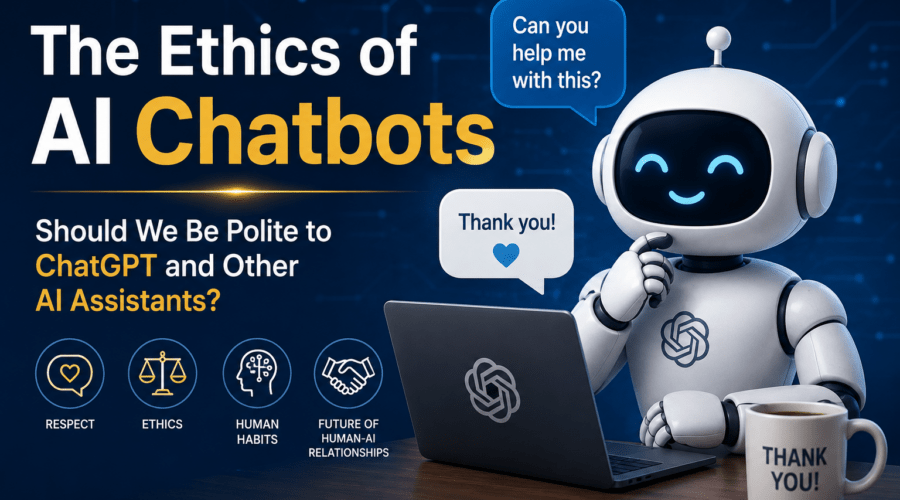
Artificial Intelligence has rapidly become part of everyday life. Millions of people now interact daily with AI assistants such as ChatGPT, Claude, Gemini, Copilot, and many others. We ask them questions, seek advice, generate content, write code, solve problems, and even engage in casual conversations.
As these interactions become more common, an interesting question has emerged:
Should we be polite to AI?
Do we need to say “please” and “thank you” when interacting with chatbots? Is there any ethical reason to treat artificial intelligence with courtesy? Or is it simply a machine that processes information and therefore does not care how we speak to it?
While there is no simple answer, the discussion raises fascinating questions about technology, human behavior, and the future of our relationship with intelligent machines.
AI Does Not Have Feelings
Let’s begin with an important fact.
Current AI systems do not have emotions, consciousness, self-awareness, or personal feelings. When you thank ChatGPT, it does not feel appreciated. When you insult it, it does not feel hurt.
Unlike humans, AI does not experience happiness, sadness, anger, embarrassment, or gratitude.
When you type:
“Thank you for your help.”
The AI processes the words as data and generates an appropriate response. It does not experience the emotional meaning behind the message.
From a purely technical perspective, there is no requirement to be polite.
The AI will answer your question whether you say:
“Please help me write an email.”
or
“Write an email now.”
The system will likely produce a similar result either way.
Then Why Do Many People Say Please and Thank You?
Even though AI lacks feelings, many users naturally communicate politely.
Why?
Because humans develop habits.
The way we speak to others becomes part of our character. People who regularly use respectful language often find it difficult to suddenly become rude—even when interacting with a machine.
Saying “please” and “thank you” is not necessarily about protecting the AI’s feelings. It may simply reflect the kind of person we choose to be.
Courtesy is often less about the recipient and more about the speaker.
The Habit Theory
Imagine someone spends hours every day speaking aggressively to chatbots:
“Do this.”
“Wrong.”
“You’re useless.”
Will that behavior remain isolated to machines?
Perhaps.
But perhaps not.
Human psychology suggests that repeated habits shape behavior over time. The language we practice becomes the language we use.
If we normalize impatience, rudeness, and hostility in thousands of daily interactions—even with machines—we may gradually become more comfortable using the same tone with real people.
On the other hand, maintaining respectful communication may reinforce positive habits that carry over into human relationships.
This is one reason many parents encourage children to use polite language when interacting with voice assistants such as Alexa or Google Assistant.
The goal is not to protect the machine.
The goal is to protect the child’s character.
Does Politeness Improve AI Responses?
Surprisingly, many users report that polite and detailed prompts often produce better results.
This does not happen because the AI feels respected.
Rather, polite communication often includes clearer instructions and more context.
Consider these examples:
Prompt A
“Write blog.”
Prompt B
“Could you please write a 1,500-word blog post about AI ethics for a general audience?”
The second prompt is not better because it contains the word “please.”
It is better because it provides more information.
Users who communicate politely often communicate more clearly, and clearer instructions usually lead to better outputs.
The Ethical Question
Some philosophers argue that our treatment of AI matters even if AI has no feelings.
Their reasoning is simple:
The way we behave toward anything reflects our values.
If someone constantly practices cruelty—even toward objects or machines—it may influence their overall character.
Others disagree.
They argue that there is a fundamental difference between humans and machines.
Humans deserve respect because they possess consciousness, dignity, and moral worth.
Machines do not.
Therefore, they say, there is no ethical obligation to treat AI politely.
Both perspectives raise valid points.
What Happens When AI Becomes More Human-Like?
Today’s AI systems are impressive, but they are still tools.
However, future systems may become increasingly realistic.
They may speak naturally, remember past conversations, display human-like personalities, and simulate emotions with remarkable accuracy.
As this happens, people may develop emotional attachments to AI companions.
Some already have.
This creates new ethical questions:
- Is it acceptable to verbally abuse an AI companion?
- Should AI be designed to tolerate harassment?
- Could abusive interactions affect human psychology?
- Should society encourage respectful treatment of highly human-like systems?
These questions become more important as technology advances.
Religious and Moral Perspectives
Many religious traditions teach that kindness should be practiced universally.
For example, in Islam, good character is highly valued. Muslims are encouraged to speak kindly, avoid harsh language, and treat others with respect.
A Muslim who says “please” and “thank you” to an AI may not believe the AI has feelings.
Rather, they may see courtesy as part of their own character and relationship with God.
Similarly, many Christians, Jews, Buddhists, Hindus, and people of other faiths view kindness as a virtue that should be practiced consistently.
In this view, politeness toward AI is not about the machine.
It is about the person.
The Cost of Courtesy
There is one humorous argument against excessive politeness.
Some technology experts have joked that billions of “please” and “thank you” messages consume computing resources.
Every word processed by AI requires servers, electricity, and infrastructure.
Of course, the impact of a single polite phrase is tiny.
Still, when multiplied across hundreds of millions of interactions, even small additions increase computational costs.
Should we stop being polite to save electricity?
Probably not.
But it is an interesting reminder that AI interactions are not entirely free.
A Balanced Approach
So what should we do?
A balanced approach may be best.
Recognize that AI is a tool.
Do not confuse it with a human being.
Do not assign emotions to systems that do not possess them.
At the same time, there is little harm in being courteous.
Using respectful language can reinforce positive communication habits, encourage clearer instructions, and reflect the values we wish to maintain in our daily lives.
You do not have to thank your calculator.
You do not have to apologize to your smartphone.
But if saying “please” and “thank you” helps cultivate patience, respect, and good manners, there is little downside.
Final Thoughts
The debate over AI ethics often focuses on complex issues such as privacy, bias, transparency, and safety.
Yet a seemingly simple question—”Should we be polite to AI?”—reveals something deeper.
The answer may not be about artificial intelligence at all.
It may be about us.
Current AI systems do not need our courtesy.
They do not feel appreciation, offense, or gratitude.
But humans do.
The habits we practice shape the people we become.
Whether you choose to speak politely to ChatGPT, Claude, Gemini, or any other AI assistant, remember that courtesy is ultimately a reflection of your own character—not the machine’s.
And perhaps that is the most important ethical lesson of all.
Leave a Comment