Real-World Marketing Case Study
If you run a website and you’ve ever clicked the big blue “Boost” or “Promote” button on a Facebook or Instagram post, I want to share a mistake that might save you some real money.
The Numbers That Looked Great — And Weren’t
I run AsianThrill, a dating platform, and like a lot of small business owners, I handle much of my own marketing.
A few weeks ago, I put together a Facebook and Instagram ad with a nice creative and a clear “Join Free” call to action, then let it run.
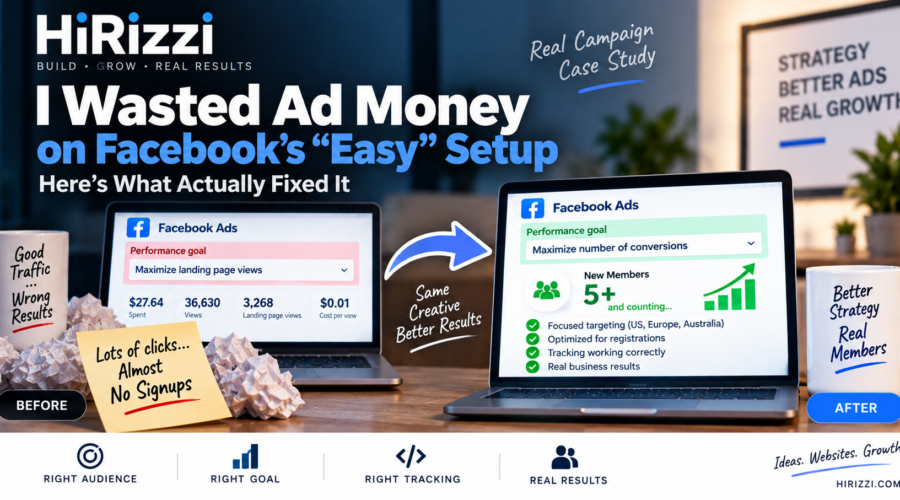
After 17 days, my Ads Manager dashboard showed:
Spent
Views
Landing Page Views
Per Landing Page View
One cent per landing page view looked incredible.
If you’ve ever run online advertising, you can understand why that number immediately caught my attention.
But there was one major problem:
Almost nobody was actually joining the site.
The Puzzle
More than 3,000 people supposedly reached my landing page, yet almost none became members.
That wasn’t a normal conversion drop-off. Something between the advertising campaign, the audience, the website and the tracking setup clearly wasn’t aligned with the outcome I actually wanted.
I brought the problem to Claude, Anthropic’s AI assistant, to help me systematically work through the possible causes.
At that point, I genuinely didn’t know where the problem was.
Was my signup form broken? Was the tracking wrong? Were people reaching the wrong page? Or was the advertising itself attracting traffic that simply wasn’t likely to register?
Once we started looking at the data more closely, the answer became much clearer.
Problem #1: My Ad Was Reaching the Wrong Markets
Google Analytics gave me one of the first major clues.
My top countries for site traffic during the period I reviewed included Indonesia, the Philippines, Laos, Vietnam and Cambodia.
The United States — one of the markets I actually cared most about — barely registered, with only around 20 users during the period I was reviewing.
That immediately made me look more closely at the campaign’s geographic targeting.
I discovered that the ad was targeting a very broad collection of markets, including:
- Hong Kong
- Japan
- Cambodia
- South Korea
- Laos
- Malaysia
- Philippines
- Singapore
- Thailand
- Taiwan
- United States
- Parts of Europe
That broad targeting may have made sense when I was experimenting with broader reach, but it didn’t match what I now wanted the campaign to accomplish.
With such a broad geographic target and a campaign optimized for landing page views, Meta’s delivery system had considerable freedom to find lower-cost opportunities.
In my case, the resulting traffic ended up heavily concentrated in lower-cost markets rather than the countries where I most wanted to build membership.
Suddenly, that $0.01 landing page view made a lot more sense.
It looked like an incredible advertising bargain, but those inexpensive visits weren’t producing the registrations I actually cared about.
Problem #2: My Campaign Was Optimized for the Wrong Result
This turned out to be the more important discovery.
When I looked closely at the ad set’s actual configuration, the performance goal was:
Maximize number of landing page views.
Not registrations.
Not completed signups.
Not new members.
Landing page views.
In other words, the advertising system was largely doing what I had configured it to do: find people likely to reach the page.
My mistake was assuming that a campaign producing lots of inexpensive visitors was automatically working toward the business result I really wanted.
It wasn’t.
A Traffic campaign can produce impressive traffic numbers without necessarily producing registrations, purchases or leads.
For my business, the real success metric wasn’t:
How cheaply can I get someone to visit a page?
It was:
How efficiently can I get a qualified visitor to complete registration?
I Couldn’t Simply Turn the Old Campaign Into the Campaign I Needed
Once I understood the problem, I initially thought I could just change a few settings and continue.
In practice, changing the campaign’s fundamental objective and optimization setup wasn’t as simple as changing one field on the existing campaign.
I ultimately rebuilt the campaign around the result I actually wanted.
Instead of focusing on Traffic / Landing Page Views, I created a conversion-oriented campaign and connected it to the website event representing a completed registration.
Now the advertising setup was aligned with the actual business goal:
Complete Registration
Problem #3: I Was Looking at the Wrong Tracking Dataset
During the troubleshooting process, I ran into another source of confusion.
My Meta setup showed more than one tracking dataset, and at one point I was looking at an old, inactive one in Events Manager.
Because that dataset showed little or no activity, I initially thought my website tracking might not be working at all.
It turned out that the real Meta Pixel connected to the website was already working correctly in the proper account, and the Complete Registration event was already being recorded.
So the problem wasn’t a broken or incorrectly installed Pixel. I was simply looking at the wrong dataset while troubleshooting.
Once I identified the active Pixel and confirmed that the registration event was firing, I could focus on the real advertising problems: where the campaign was delivering traffic and what outcome it was optimized to achieve.
That experience was still a useful reminder that when you’re troubleshooting Meta advertising, it’s worth confirming:
- Which Pixel or dataset is actually connected to your website
- Which Meta account owns or has access to it
- Whether your important conversion events are being received
- Whether your campaign is optimizing toward the event you actually care about
The Fix, In Plain English
In the end, I made three major changes.
1. I Narrowed the Geographic Targeting
I stopped targeting a huge collection of countries simply because they were available.
Instead, I focused the campaign on the markets where I actually wanted to attract members, including the United States, Australia and selected European markets.
2. I Changed What the Campaign Was Trying to Accomplish
Instead of optimizing around landing page views, I rebuilt the campaign around conversion-oriented performance and the action that actually matters to the business:
Complete Registration
3. I Verified the Tracking Setup
I confirmed that I was looking at the correct Meta Pixel and dataset, and verified that the Complete Registration event was already being recorded properly.
The Result
I kept essentially the same ad creative and stayed within a similar budget range.
But after relaunching with the corrected targeting, conversion-oriented setup and tracking configuration, I began seeing something that mattered much more than cheap clicks:
5 new members — and counting — within days.
That was a significant improvement over the near-zero registrations I had been seeing before.
And yes, my cost per click went up.
A lot.
That beautiful $0.01 number disappeared.
I was perfectly happy to see it go.
I’d rather pay more for traffic that has a realistic chance of becoming a member than celebrate extremely cheap traffic that produces no meaningful business result.
The Bigger Lesson
Advertising dashboards can make a campaign look impressive when you’re paying attention to a metric that isn’t aligned with your real business objective.
Reach can look great.
Impressions can look great.
Engagement can look great.
Clicks can look great.
Landing page views can look great.
None of those numbers automatically means your actual business objective is being achieved.
For one business, success might mean a purchase.
For another, it might mean a booked appointment or a qualified sales lead.
For a dating platform like mine, it means people actually completing registration and becoming members.
The most important question isn’t:
“Is my ad getting traffic?”
It’s:
“Is my campaign optimized for the action that actually matters to my business?”
If You’re Running Your Own Facebook Ads
If you’re a small business owner running your own campaigns, take an extra few minutes before spending money and check three things:
Check Your Performance Goal
Don’t just check whether your ad is active.
Look at what the campaign is actually being asked to optimize for.
Check Your Locations
Make sure your ads are being shown in the countries and markets where you genuinely want customers.
Check Your Conversion Tracking
Make sure the action you actually care about — registration, purchase, lead, booking or something else — is being measured correctly.
Then make sure your campaign is actually optimizing toward that action.
Lesson Learned
My original campaign wasn’t necessarily “broken.”
In many ways, it was doing what it had been configured to do.
I had simply configured it to pursue the wrong outcome.
A dashboard can look fantastic when a campaign is optimizing for an inexpensive metric. But if that metric isn’t aligned with your actual business goal, those impressive numbers can be misleading.
The metrics that matter most are the ones tied to the outcome you’re actually trying to achieve.
That’s an expensive lesson — but a much cheaper one to learn now than after months of advertising to the wrong audience while celebrating numbers that weren’t helping the business.
Leave a Comment