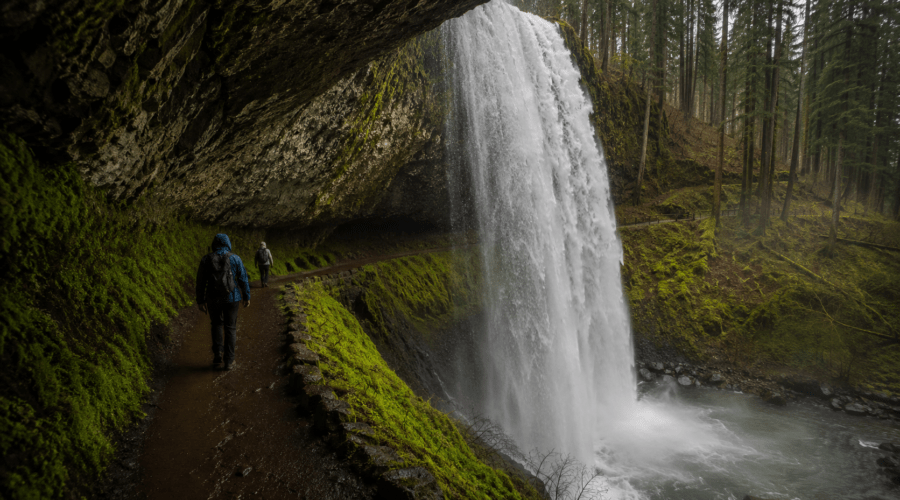
There are days when you need to step completely away from the screen.
No code editor. No WordPress dashboard. No plugin conflicts to debug or CSS to fix. Just fresh air, the sound of moving water, and a trail that takes you somewhere your laptop can’t follow.
Silver Falls State Park in Oregon was that day for me.
Oregon’s Crown Jewel
Silver Falls is the largest state park in Oregon, covering more than 9,000 acres near Silverton, about 20 miles southeast of Salem. I’d heard about it for a while — it kept coming up whenever people talked about Oregon hiking — but I hadn’t made the trip. When I finally did, I understood immediately why it has a reputation.
The Trail of Ten Falls is legendary — you get to walk behind four massive waterfalls, which feels like being in a secret water cave. The forest is super lush, green, and mossy, basically a real life fairy tale.
That description sounds like marketing copy until you’re actually standing there. Then it just sounds accurate.
The Trail of Ten Falls
The Trail of Ten Falls is a 7.2-mile loop trail that takes hikers to the foot of 10 waterfalls — several of which are 100 feet or taller — behind four of them, and into the heart of a lush, forested canyon that’s accessible all year long.
The full loop is listed as moderate, and that feels right. There’s real elevation involved — about 1,300 feet of elevation gain — but most hikers barely notice the rolling hillsides and enjoy the opportunity to stop and catch their breath at the base of a thundering waterfall.
I started at the South Falls trailhead, which is where most people begin. The trail descends into the canyon through a corridor of towering Douglas firs, ferns pushing out in every direction, and the sound of water growing louder with every step.
Then South Falls comes into view.
South Falls drops 177 feet into a wide canyon, and the trail curves behind it, giving you that unforgettable view from the shadowy rock alcove as the water crashes in front of you. Standing behind a 177-foot waterfall with the roar surrounding you and the mist hitting your face is one of those moments that doesn’t fit into a photo. You just have to be there.
Walking Behind the Water
This is the part that makes Silver Falls genuinely unique. Four of the ten waterfalls on the trail allow you to walk directly behind them — through natural alcoves carved into the basalt by centuries of erosion.
The geology explains it: all waterfalls in the park spill over 15-million-year-old Columbia River basalt. The water of Silver Creek flows over this thick basalt lava flow resting on softer, older rock. As the water loses elevation, this softer layer beneath has eroded and created a natural pathway.
Walking through that pathway while the water crashes a few feet in front of you is something else entirely. It’s immersive in a way that very few outdoor experiences are — you’re not watching the waterfall, you’re inside it.
Hikers follow the Canyon Trail behind South Falls. Walking underneath the waterfall, with mist in the air and water crashing just a few feet away, was exhilarating. It felt immersive, like stepping into a landscape photo instead of just looking at it.
That’s exactly it.
The Rest of the Trail
After South Falls, the trail follows Silver Creek deeper into the canyon. Each waterfall is different — different height, different character, different relationship with the rock and the light.
The waterfalls along the route include South Falls, Lower South Falls, Lower North Falls, Double Falls, Drake Falls, Middle North Falls, Winter Falls, Twin Falls, North Falls, and Upper North Falls. Double Falls is even taller than South Falls at about 178 feet, making it the tallest waterfall in the park.
Lower South Falls is broader and quieter than its famous neighbor — a wide 93-foot cascade that feels like the canyon has finally exhaled. Middle North Falls has an elegant curtain quality to it. North Falls, at 136 feet, you approach from above, watching the creek narrow and drop into a rocky chute before the big reveal.
What makes Silver Falls so special is not just one waterfall. It is the way the entire trail unfolds. You start with one jaw-dropping view, then another, then another. The canyon keeps pulling you forward.
That forward pull is real. I kept thinking “okay, one more” all the way around.
Practical Notes If You’re Planning a Visit
A few things worth knowing before you go:
Parking has a fee. Day-use parking passes can be purchased at the South Falls and North Falls parking areas, or online in advance. South Falls has significantly more parking than North Falls, so arriving early at South Falls is the safer bet, especially on weekends.
No pets on the Canyon Trail. This is a firm rule and for good reason — the trail is narrow, wet, and rocky in sections. Pets are allowed on all other trails in the park on a leash.
The trail is not suitable for strollers. Some sections are paved, but the canyon portions are packed gravel and rock. Baby carriers work fine.
Sturdy shoes are a must. The trail gets muddy and wet, and some sections near the falls are genuinely slippery. Don’t do this in sneakers.
As of April 2026, there’s a partial closure on the Canyon Trail from the bottom of the Twin Falls Trail to the junction with the Rim Trail near the North Falls Trailhead. Check the Oregon State Parks website for current trail conditions before you go.
If you can’t do the full 7.2 miles, shorter options exist. A few connecting trails make it easy to shorten your day while still seeing several scenic waterfalls — from a quick one-mile outing that descends to the base of South Falls to a five-mile loop that showcases seven scenic waterfalls.
The Part I Didn’t Expect
I went to Silver Falls expecting beautiful scenery. What I didn’t expect was how completely it would quiet everything else down.
I spend a lot of time in front of screens solving problems. Most of my day is some version of figuring out why something isn’t working — a plugin conflict, a CSS layout issue, a database query that’s returning the wrong result. That’s satisfying work, but it’s a certain kind of mental engagement that doesn’t really switch off on its own.
The trail switched it off. Somewhere around the third waterfall — standing in the alcove behind Lower South Falls, the roar making conversation impossible, the mist cold on my face — I realized I hadn’t thought about code in over an hour.
That’s the thing about a place like this. It doesn’t just occupy your senses. It replaces them with something better.
One More Thing
Spending time in places like Silver Falls is part of what informs my interest in international relocation and quality of life — topics I write about on GlobalRelocateUSA.com, a resource platform I built for Americans exploring life abroad.
The connection might not be obvious, but I think it is: people who are drawn to places like Silver Falls — who respond to natural beauty, to a slower pace, to being somewhere genuinely quiet — are often the same people who find that a different country offers a kind of daily life they couldn’t access at home.
If that resonates with you at all, GlobalRelocateUSA.com is worth a look.
And if you haven’t been to Silver Falls — go. Take a full day. Wear real shoes. Walk behind the water.
You’ll figure out the rest from there.
Silver Falls State Park is located near Silverton, Oregon, approximately 20 miles southeast of Salem. The park is open year-round. Parking fees apply. Check Oregon State Parks for current conditions, closures, and reservations.
Leave a Comment