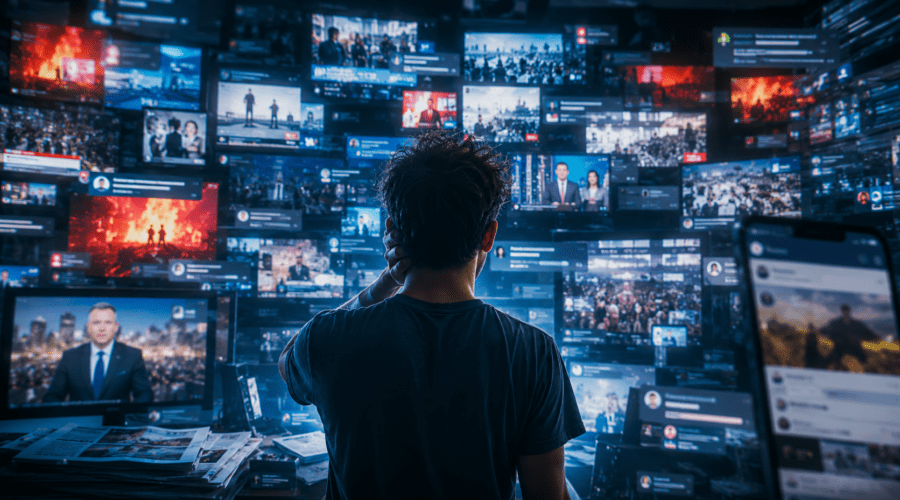
There was a time when mainstream media was considered one of the most trusted sources of information in society. Millions of people watched the same evening news broadcasts, read the same newspapers, and relied on major television networks to understand what was happening in the world.
Today, that trust has changed dramatically.
Across many countries, public confidence in mainstream media continues to decline. People from different political backgrounds, age groups, and cultures increasingly question whether the news they consume is fully accurate, balanced, or free from outside influence.
So what happened?
The answer is complicated. It is not simply about “fake news” or politics. The decline in trust comes from a combination of technological, social, economic, and psychological changes that have transformed how information is created and consumed.
The Internet Changed Everything
One of the biggest reasons people no longer trust traditional media is the internet itself.
Before social media and smartphones, information moved slowly. Large media companies controlled most television channels, newspapers, and radio stations. The public had fewer alternative sources to compare information with.
Now, anyone can publish opinions, videos, reports, and eyewitness footage online within seconds.
This has both positive and negative effects.
On one hand, people now have access to more perspectives than ever before. Independent journalists, researchers, bloggers, and even ordinary citizens can share information directly with the world.
On the other hand, the internet also created information overload. With millions of competing voices online, people constantly encounter conflicting narratives, opinions, and interpretations of events.
As a result, many individuals began questioning whether traditional media outlets were always presenting the full picture.
Political Polarization Increased Distrust
Modern politics has become increasingly divided, especially online.
Many people believe news organizations favor one political side over another. Others feel media companies selectively cover stories depending on which narratives generate more attention, clicks, or emotional reactions.
When audiences repeatedly see reporting that appears one-sided, trust naturally declines.
At the same time, critics from every political direction often accuse media outlets of bias. Interestingly, this distrust is no longer limited to one ideology. Conservatives, liberals, independents, and younger audiences all express skepticism for different reasons.
This widespread suspicion has created an environment where many people assume hidden agendas exist behind major headlines.
Social Media Changed Human Psychology
Social media platforms changed not only how news spreads, but also how humans emotionally react to information.
Algorithms prioritize content that generates strong engagement — anger, fear, outrage, and controversy often receive more visibility than calm analysis.
Because of this, sensational headlines and emotionally charged stories spread faster than balanced reporting.
Over time, audiences became exhausted by constant negativity, conflict, and breaking news cycles. Many people now feel that media organizations focus too heavily on fear-driven content because it increases ratings, clicks, and advertising revenue.
This perception damages credibility even when accurate journalism is still being produced.
Corporate Ownership Raises Questions
Another major concern involves media ownership.
Many mainstream media companies are owned by large corporations with business interests, investors, and political relationships. Critics argue that this can influence editorial decisions, story priorities, or how certain topics are framed.
Whether those concerns are fully justified or not, public awareness of corporate influence has grown significantly in recent years.
People increasingly ask:
- Who funds this organization?
- What interests are involved?
- Is this story being presented objectively?
These questions contribute to a broader climate of skepticism.
Trust Declines When Mistakes Happen
No media organization is perfect.
When major outlets publish incorrect information, misleading headlines, or incomplete reporting, public reactions can be severe — especially in the digital age where mistakes spread rapidly online.
Even when corrections are later issued, the damage to public confidence may already be done.
Many people now compare multiple sources before believing major stories. Others rely more heavily on independent creators, podcasts, newsletters, or direct video footage from events themselves.
Younger Generations Consume Information Differently
Younger audiences often no longer depend on television news at all.
Instead, they get information from:
- YouTube
- TikTok
- Podcasts
- X/Twitter
- Independent newsletters
- Online communities
This creates a major cultural shift.
Traditional media organizations now compete with millions of independent voices for public attention. In some cases, independent creators feel more authentic and relatable to audiences than highly polished corporate broadcasts.
However, independent media also comes with risks, including misinformation, lack of verification, and emotionally driven content.
The Problem Is Bigger Than Media Alone
The decline in trust reflects a deeper societal issue.
People today are overwhelmed by:
- political conflict
- economic uncertainty
- rapid technological change
- AI-generated content
- social media manipulation
- information overload
In this environment, many individuals struggle to know who or what to trust.
The result is not just distrust of mainstream media — but distrust of institutions in general.
Can Trust Be Rebuilt?
Despite growing skepticism, professional journalism still plays an important role in society.
Investigative reporting, fact-checking, war correspondence, scientific reporting, and accountability journalism remain valuable when done responsibly and transparently.
Rebuilding public trust may require:
- greater transparency
- clearer separation between news and opinion
- admitting mistakes openly
- reducing sensationalism
- focusing on accuracy over speed
- encouraging critical thinking among audiences
At the same time, readers also have a responsibility to verify information carefully and avoid blindly trusting any single source — whether mainstream or independent.
Final Thoughts
The decline of trust in mainstream media did not happen overnight. It developed over years through political division, technological disruption, social media algorithms, corporate influence concerns, and changing human behavior online.
Some skepticism toward media can be healthy. Questioning information critically is part of an informed society.
But complete distrust of all information sources can also become dangerous if people stop caring about facts altogether.
In the end, the challenge for modern society is not simply finding information — it is learning how to navigate an endless flood of information wisely, calmly, and critically.
Leave a Comment